

If DEA personnel hand you a Form DEA-82 (Notice of Inspection), they are asking for consent, and you can refuse or call a lawyer first. If they present an administrative inspection warrant or a criminal search warrant signed by a judge, you cannot refuse entry. In every case, you have the right to stay silent and to see a copy of the paperwork. You can also call a healthcare fraud defense lawyer immediately. Never sign a DEA Form 104 surrendering your registration on the spot.
When DEA personnel arrive at a medical practice, pharmacy, or clinic, the first question is not what they want. It is what legal authority they are using to be there. The DEA can enter a registered business in three very different ways, and each one gives you different rights. Knowing the difference in the first five minutes can decide whether the visit ends as a records review or becomes evidence in a federal prosecution.
This guide explains how DEA search warrants work and what to do while agents are on site. It also covers how a defense lawyer protects your registration and your freedom after they leave. It is written by the federal defense team at Lowther | Walker, led in part by Murdoch Walker, II, a former DEA Task Force Officer.
The Three Ways the DEA Can Enter Your Practice or Pharmacy
The Controlled Substances Act gives the DEA inspection authority over every registrant under 21 U.S.C. § 880, with detailed procedures in 21 C.F.R. §§ 1316.03–1316.13. Criminal searches follow a separate track under the Fourth Amendment and Federal Rule of Criminal Procedure 41. In practice, an entry falls into one of three categories.
| Form DEA-82 (Notice of Inspection) | Administrative Inspection Warrant | Criminal Search Warrant | |
|---|---|---|---|
| Legal authority | 21 U.S.C. § 880; 21 C.F.R. § 1316.08 | 21 U.S.C. § 880(d); 21 C.F.R. §§ 1316.09–1316.13 | Fourth Amendment; Fed. R. Crim. P. 41 |
| Who approves it | No judge. It is a request for your written consent. | A federal judge or magistrate judge | A federal judge or magistrate judge |
| Standard required | Your voluntary, informed consent | A valid public interest in enforcing the Controlled Substances Act, not proof of a crime | Probable cause that evidence of a crime will be found |
| Who usually conducts it | Diversion Investigators | Diversion Investigators | Special Agents, often with task force officers and other agencies |
| Can you refuse? | Yes, and you can withdraw consent at any time | No | No |
| What it usually signals | A regulatory compliance review that can still uncover criminal evidence | A compliance concern serious enough that DEA went to court | An active criminal investigation |
![Comparison of Form DEA-82, a DEA administrative inspection warrant and a criminal search and seizure warrant, showing which ones you can refuse]](https://federal-criminal-lawyer.com/wp-content/uploads/which-dea-document-is-in-your-hand-1024x612.webp)
1. Form DEA-82: A Notice of Inspection Is a Request for Consent
Most DEA site visits begin with a Diversion Investigator presenting Form DEA-82. Under 21 C.F.R. § 1316.08, the DEA must obtain your written consent and tell you, in writing, that:
- You have a constitutional right not to allow an inspection without a warrant
- Anything incriminating found during the inspection may be seized and used against you
- You may withdraw your consent at any time during the inspection
Many registrants sign the form believing they have no choice. You do. You can ask the investigators to wait while you call a lawyer, or ask them to return at a scheduled time. Refusing consent is not obstruction. If the DEA wants to proceed anyway, it will usually need to obtain an administrative inspection warrant.
Whether to consent is a strategic call. Refusing can signal to DEA that something is wrong, and investigators will often return with a warrant. Consenting under a lawyer’s guidance, with a defined scope and an attorney present, sometimes produces a better result. That decision should be made with counsel, not at the front desk.
2. Administrative Inspection Warrants
An administrative inspection warrant (AIW) is issued by a federal judge but does not require evidence of a crime. Under 21 U.S.C. § 880(d)(1), “probable cause” for an AIW means a valid public interest in effective enforcement of the Controlled Substances Act sufficient to justify the inspection. In practice, DEA must describe the premises and the nature of the inspection. The application also identifies the records or items it seeks.
The warrant is limited in ways that matter:
- It must generally be executed within 10 days of issuance (21 C.F.R. § 1316.11).
- Inspections take place during regular business hours.
- Investigators may review and copy records and count controlled substance inventory. They may not search beyond what the warrant describes.
You cannot refuse an AIW. Its scope, however, is narrower than a criminal warrant, and a lawyer on the phone or on site can object when investigators go beyond it.
3. Criminal Search Warrants
A criminal search warrant means the DEA believes a federal crime has been committed, typically unlawful distribution of controlled substances, pharmaceutical diversion, or healthcare fraud. A judge must find probable cause based on an affidavit, and the warrant must describe with particularity the place to be searched and the items to be seized.
Under Rule 41(e)(2), a criminal warrant must be executed within 14 days and during the daytime, defined as 6:00 a.m. to 10:00 p.m., unless the judge authorizes otherwise for good cause. Agents must leave a copy of the warrant and a receipt for property taken (Rule 41(f)). The supporting affidavit, which lays out the government’s evidence, is usually filed under seal. You will rarely see it on the day of the search.
Criminal warrants commonly authorize seizure of:
- Patient charts and electronic health records
- Prescription records and dispensing logs
- Controlled substance inventories
- DEA Form 222 order forms and CSOS records
- Computers, servers and phones, which may be copied on site or taken for off-site review under Rule 41(e)(2)(B)
- Bank records and billing data
- Cash
Diversion Investigators or Special Agents: Who Shows Up Tells You a Lot
The DEA employs two kinds of personnel who visit registrants, and identifying them is one of the fastest ways to understand your exposure.
Diversion Investigators handle the regulatory side. They conduct audits and review records under Form DEA-82 or an AIW, with the goal of enforcing registration requirements. They are not armed law enforcement officers in the traditional sense, and their findings usually lead first to administrative action against your registration.
Special Agents are federal criminal investigators. When armed agents arrive with a criminal search warrant, often alongside local officers serving on a Tactical Diversion Squad, the investigation is criminal. HHS-OIG agents or FBI agents may join them when billing fraud is also suspected.
Ask every person on site for identification and a business card, and note which agency each represents. If Special Agents are present for what is described as a “routine inspection,” treat the visit as a criminal matter and call a lawyer before answering any questions.
Why the DEA Targets a Physician, Clinic or Pharmacy
DEA investigations of registrants rarely start at random. Investigators build cases from data long before anyone arrives on site. Common sources include:
- ARCOS data, which tracks controlled substances shipped from manufacturers and distributors to each registrant
- Prescription drug monitoring program (PDMP) data showing prescribing volume, dosage or patient travel patterns
- Suspicious order reports filed by wholesalers who flag a pharmacy’s purchasing
- Pharmacist refusals to fill a prescriber’s prescriptions
- Former employees, patients or competitors who report concerns
- Patient overdoses or deaths linked to a prescriber or pharmacy
- Medicare Part D and Medicaid claims data analyzed by HHS-OIG
Investigators then look for red flags associated with diversion. For prescribers, these include high-dose opioid prescribing without documented exams, frequent combinations of opioids with benzodiazepines and muscle relaxants, cash-only practices, and patients who travel long distances. For pharmacies, investigators focus on prescriptions filled despite unresolved red flags. Early refills and inventory discrepancies draw attention as well. Pharmacists carry a “corresponding responsibility” under 21 C.F.R. § 1306.04(a) to fill only prescriptions issued for a legitimate medical purpose.
None of these factors proves wrongdoing. Pain management and addiction medicine practices often show patterns that look suspicious in raw data but are medically justified. Showing that context is a central part of the defense.
What to Do When the DEA Arrives With a Warrant
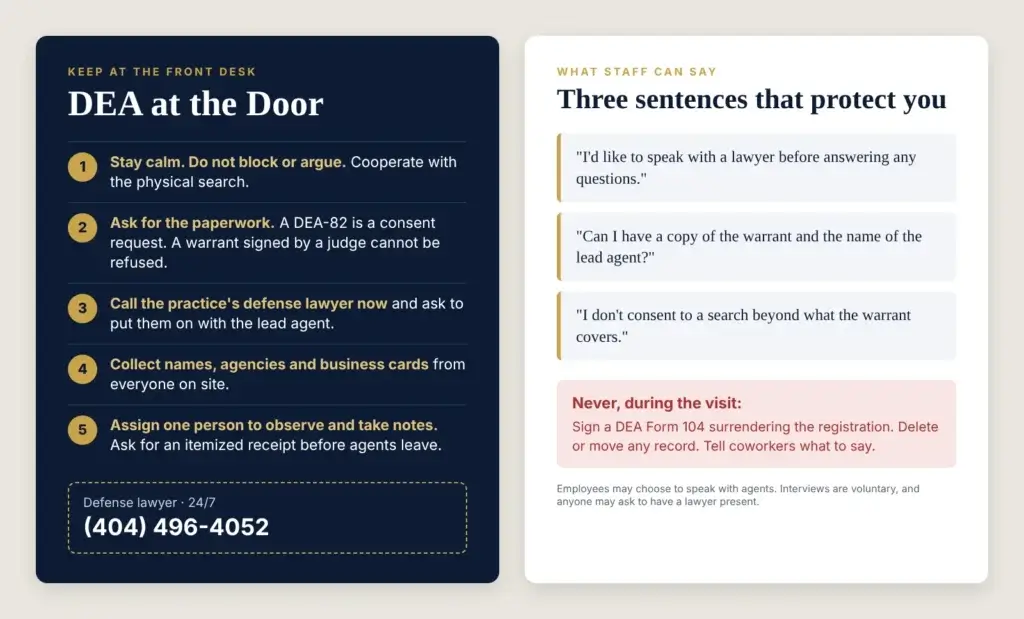
The hour agents are on site is chaotic. A clear plan protects you and your staff. Keep this list at the front desk.
Do
- Stay calm and cooperate with the physical search. Do not block doors, hide records or argue with agents.
- Ask for a copy of the warrant or Form DEA-82 and read it. Note whether it is a consent form, an administrative warrant or a criminal warrant.
- Call your defense lawyer immediately and, if possible, let the lawyer speak with the lead agent.
- Identify the lead agent and every agency present, and collect business cards.
- Designate one staff member to observe the search and take notes on which rooms and devices agents enter, without interfering.
- Identify privileged materials. Tell agents which files or devices contain communications with lawyers and ask that they be segregated for review by a filter team.
- Request a detailed inventory of everything seized before agents leave.
- Ask whether you can keep copies of patient records needed for ongoing care, or whether agents will image devices instead of taking them.
Do Not
- Do not answer substantive questions about prescribing, dispensing or billing. You have a Fifth Amendment right to remain silent, and declining to answer is not obstruction.
- Do not lie or guess. A false statement to a federal agent is a separate felony under 18 U.S.C. § 1001, even if the underlying conduct was lawful.
- Do not delete, move or alter any record, including texts and emails. Destroying records during a federal investigation can be charged under 18 U.S.C. § 1519, which carries up to 20 years.
- Do not instruct staff not to talk to agents. You can tell them that interviews are voluntary and that they may have a lawyer present. Telling them to refuse or to give a particular account can be charged as witness tampering.
- Do not sign a DEA Form 104. See the next section.
Never Sign a DEA Form 104 During the Search
DEA personnel sometimes present a DEA Form 104, a voluntary surrender of controlled substance privileges, during or right after a search or inspection. They may suggest that signing will make things easier. Signing gives up your registration immediately, without the hearing rights you would otherwise have. It can also trigger reporting to your state licensing board and make a future registration much harder to obtain.
Surrender is occasionally the right strategic choice, for example, as part of a negotiated resolution. That choice should be made days later, with counsel, after reviewing the evidence. It should never be made under pressure while agents are still in the building.
Your Rights During a DEA Search
- The right to see the warrant. Agents must provide a copy of a criminal warrant and a receipt for what they take.
- The right to remain silent. You and your employees do not have to answer questions during a search.
- The right to counsel. You can call a lawyer at any point. Agents are not required to wait for the lawyer before searching under a warrant, but your lawyer can speak with the lead agent about scope and privileged materials.
- The right to refuse consent. With Form DEA-82, you can decline or withdraw consent. Under any warrant, you can decline consent to search anything outside the warrant’s scope.
- The right to protect privileged materials. Attorney-client communications should be segregated and reviewed by a separate government filter team, not the investigating agents.
What Happens After the DEA Leaves
The search is the beginning, not the end. The steps taken in the next 72 hours shape both the administrative and the criminal cases.
The First 72 Hours
- Retain federal defense counsel and route every future government contact through your lawyer.
- Debrief staff through counsel. Your lawyer should interview employees about what agents asked and what was said, in a privileged setting.
- Compare the inventory receipt with what is actually missing, and document any discrepancies.
- Restore patient care. Arrange access to records needed for ongoing treatment, and plan for continuity if your ability to prescribe controlled substances is restricted.
- Issue a preservation instruction covering every record and device, including personal accounts used for work.
- Assess billing exposure. If controlled substance prescribing is in question, Medicare and Medicaid claims tied to those visits often are too.
Getting Your Property Back
Seized computers and records can cripple a practice. Your lawyer can often negotiate with prosecutors for forensic copies or the prompt return of devices once they are imaged. When negotiation fails, Rule 41(g) allows a person aggrieved by a seizure to move for the return of property. Cash and other assets seized during a search may be subject to civil asset forfeiture proceedings, which carry strict deadlines for filing a claim.
![Timeline of the administrative registration case and the criminal case that follow a DEA search]](https://federal-criminal-lawyer.com/wp-content/uploads/after-dea-search-administrative-criminal-timeline-1024x606.webp)
What a DEA Search Means for Your Registration
Even if no criminal charges are ever filed, the DEA can act against your registration under 21 U.S.C. § 824. These administrative proceedings move faster than criminal cases and can end a practice.
Order to Show Cause
The DEA typically begins proceedings with an Order to Show Cause (OSC) explaining why it proposes to revoke, suspend, or deny your registration. You generally have 30 days to request a hearing before an administrative law judge or submit a written statement (21 C.F.R. § 1301.43). Missing that deadline can waive your right to a hearing. Under amendments made in 2016, the OSC must also allow you to submit a corrective action plan, which can resolve the matter without revocation.
Immediate Suspension Order
If the DEA finds an “imminent danger to the public health or safety,” it can issue an Immediate Suspension Order (ISO) under § 824(d), which takes effect at once. ISOs are often served the same day as a criminal search warrant. A suspended registrant cannot prescribe, dispense or order controlled substances while the proceeding continues.
Memorandum of Agreement
Many registration cases resolve through a negotiated Memorandum of Agreement. These typically require compliance measures, monitoring or limits on prescribing for a period of years while allowing the registrant to keep practicing. The terms are negotiable, and early representation affects what is offered. Our team handles these matters alongside related medical license defense before state boards.
Criminal Charges That Can Follow a DEA Search
When a criminal warrant is executed, prosecutors are often weeks or months from a charging decision. The charges we see most often after DEA searches of healthcare providers include:
- Unlawful distribution of controlled substances, 21 U.S.C. § 841, which applies to practitioners who prescribe outside the usual course of professional practice
- Conspiracy to distribute, 21 U.S.C. § 846
- Maintaining drug-involved premises, 21 U.S.C. § 856, often charged in “pill mill” cases
- Recordkeeping and registration offenses, 21 U.S.C. § 842 and § 843
- Healthcare fraud and conspiracy, 18 U.S.C. §§ 1347 and 1349, when visits or prescriptions were billed to Medicare or Medicaid
- Money laundering, 18 U.S.C. §§ 1956 and 1957
How Ruan v. United States Changed Prescriber Prosecutions
In Ruan v. United States, 597 U.S. 450 (2022), the Supreme Court held that when a licensed practitioner is charged under § 841, the government must prove beyond a reasonable doubt that the practitioner knowingly or intentionally acted in an unauthorized manner. It is not enough to show that a prescription fell outside accepted medical standards. The question is the prescriber’s own state of mind.
Ruan shifted the focus of these cases to intent. Documentation, consultations with specialists, patient agreements, and evidence of a good-faith treatment philosophy now carry significant weight. Building that record early, before prosecutors decide whether to charge, is often the most important defense work in a DEA case. Our broader federal drug offense defense practice draws on the same principles.
Can a DEA Search Warrant Be Challenged?
Yes. Evidence obtained through an unlawful search can be suppressed, and challenges to the warrant often shape plea negotiations even when they do not end the case. Common grounds include:
- Lack of probable cause. The affidavit did not establish a fair probability that evidence of a crime would be found.
- False or misleading statements in the affidavit. Under Franks v. Delaware, 438 U.S. 154 (1978), a defendant can obtain a hearing by showing that the affiant included deliberately or recklessly false statements that were necessary to the probable cause finding.
- Lack of particularity. A warrant authorizing seizure of “all records” without meaningful limits may be unconstitutionally broad.
- Exceeding the scope. Agents seized items or searched areas the warrant did not cover.
- Improper execution. The warrant was executed after its deadline or at night without authorization, or agents mishandled privileged material.
- Exceeding an administrative warrant. Investigators used an AIW, which requires no evidence of crime, as a pretext for a criminal search.
Pharmacies and other registrants are treated as a “closely regulated” industry, which gives inspectors more latitude than police have in a private home under New York v. Burger, 482 U.S. 691 (1987). That latitude has limits, and identifying where investigators crossed them requires a close review of the warrant and every item taken.
How Lowther | Walker Defends DEA Search Warrant Cases
We Know How DEA Cases Are Built
Partner Murdoch Walker, II served as a DEA Task Force Officer and spent years as a narcotics task force investigator before becoming a defense lawyer. He has seen how DEA investigators select targets and draft affidavits from the government’s side. That experience helps us read a warrant and anticipate the government’s next step. It also shows us where the government’s theory is weakest.
We Defend Both Your Registration and Your Freedom
A DEA search usually creates parallel administrative and criminal cases. We coordinate the response to an Order to Show Cause with the criminal defense strategy, so a statement made to save your registration does not become evidence against you in court.
We Respond Immediately, Nationwide
DEA searches happen without warning. Our attorneys answer calls 24/7 and represent physicians, pharmacists, nurse practitioners, and clinic owners in federal districts across all 50 states. If prosecutors follow up with grand jury subpoenas or a target letter, the defense is already in place.
Talk to a DEA Search Warrant Defense Lawyer Today
If DEA agents are at your practice right now, or have just left, the decisions you make today will affect every stage of the case. Call Lowther | Walker at (404) 496-4052, day or night, or request a free, confidential consultation.
DEA Search Warrant FAQs for Healthcare Providers
Do I have to consent if DEA investigators present a Form DEA-82?
No. Form DEA-82 is a request for consent to inspect without a warrant. You can refuse, ask investigators to wait while you call a lawyer, or withdraw consent partway through. If you refuse, the DEA may seek an administrative inspection warrant, which you cannot refuse.
How long does the DEA have to execute a warrant?
A criminal search warrant must be executed within 14 days of issuance under Rule 41(e)(2)(A). An administrative inspection warrant must generally be executed within 10 days under 21 C.F.R. § 1316.11.
Can I stop agents from entering if they have a signed warrant?
No. You cannot refuse entry under a valid criminal or administrative warrant. Physically blocking agents or hiding records can lead to obstruction charges. You can, however, decline to answer questions and decline consent to search anything beyond the warrant.
Am I required to answer questions during the search?
No. You and your employees have a Fifth Amendment right to remain silent. Give your name and contact information, then say you would like to speak with a lawyer before answering questions.
Can I keep practicing medicine after a DEA search?
Usually, yes. A search alone does not suspend your registration or medical license. If the DEA issues an Immediate Suspension Order, you cannot prescribe or dispense controlled substances while it is in effect, but you can generally continue providing other care unless your state board also acts.
Will I lose my DEA registration after a search?
Not necessarily. Most registration cases begin with an Order to Show Cause, which gives you 30 days to request a hearing and an opportunity to submit a corrective action plan. An Immediate Suspension Order takes effect at once, but it can still be contested.
Can a routine DEA inspection lead to criminal charges?
Yes. Evidence of diversion or false records found during a consent inspection or an administrative warrant inspection can be seized and referred for criminal investigation. That is why consent decisions should be made with a lawyer.
Will my patients be told about the investigation?
The DEA does not usually notify patients directly. Patients may learn of it if agents interview them, if your registration is suspended, or if charges become public. Your lawyer can help you plan patient communications that do not create additional risk.
Should my staff talk to DEA agents?
Employees can decide for themselves, and you can tell them that interviews are voluntary and that they may have a lawyer present. You should never tell them to refuse or suggest what to say, because that can be treated as witness tampering.
Why do I need a federal defense lawyer instead of a general healthcare attorney?
A DEA search can lead to administrative action and criminal charges at the same time, often with billing fraud allegations close behind. A federal criminal defense lawyer can protect your Fifth Amendment rights while coordinating the registration defense, which a regulatory lawyer alone may not be positioned to do.