Updated: November 2026
Prosecutors add a conspiracy count to almost every multi-defendant fraud case. It lets them hold each participant responsible for what the group did, use co-conspirators’ statements as evidence, and bring the case in more places. This guide explains what the government must prove, how § 1349 differs from the general conspiracy statute, and the defenses that work.
Sources: 18 U.S.C. §§ 371, 1343, 1349, 3282; United States v. Roy, 783 F.3d 418 (2d Cir. 2015). The maximum rises to 30 years, and the limitations period to 10 years, when the scheme affects a financial institution.
What Is Conspiracy to Commit Wire Fraud?
Section 1349 is a short statute. It says that anyone who “attempts or conspires to commit any offense under this chapter” faces “the same penalties as those prescribed for the offense” that was the object of the conspiracy. “This chapter” is Chapter 63 of Title 18, which includes wire fraud, mail fraud, bank fraud, health care fraud, and securities fraud.
When the object of the agreement is wire fraud under 18 U.S.C. § 1343, the charge is conspiracy to commit wire fraud. The crime is the agreement itself. A person can be convicted even if no money was ever taken, no victim was ever deceived, and the scheme fell apart before it started.
Section 1349 also covers attempt, so prosecutors can charge someone who tried to carry out a wire fraud scheme alone and failed. This guide focuses on the conspiracy side.
What Prosecutors Must Prove
To convict under § 1349, the government must prove each of the following beyond a reasonable doubt:
1. An agreement existed. Two or more people agreed to commit wire fraud. The agreement does not need to be written or even spoken; jurors can infer it from how the people acted.
2. The defendant knew its purpose. The defendant knew the agreement’s unlawful goal. Being present, working at the company, or knowing the people involved is not enough.
3. The defendant joined willfully. The defendant voluntarily joined, intending to help accomplish the fraud. Prosecutors do not need to show the defendant knew every detail or every other member.
No Overt Act Is Required
Unlike the general conspiracy statute, § 1349 does not require proof that anyone took a step to carry out the plan. In United States v. Roy (2015), the Second Circuit held that proof of an overt act is not required under § 1349, joining other circuits that reached the same result. The court relied on the Supreme Court’s reasoning in Whitfield v. United States (2005), which reached the same conclusion for money laundering conspiracy.
In practice, this means the agreement alone completes the crime. Prosecutors usually describe overt acts in the indictment anyway, because those acts are their evidence that an agreement existed.
The Object Must Be Wire Fraud as the Law Defines It
A conspiracy charge is only as strong as the fraud it targets. If the scheme the defendants agreed to would not have been wire fraud, there is no § 1349 conspiracy. Two recent Supreme Court decisions shape that question:
- Ciminelli v. United States (2023) rejected the “right to control” theory. Depriving someone of information they would have used to make a decision is not, by itself, a scheme to obtain money or property.
- Kousisis v. United States (2025) went the other way on fraudulent inducement. A unanimous Court held that wire fraud does not require proof that the defendant intended to cause economic loss, so inducing someone into a deal through material lies can be wire fraud even if the victim got what it paid for. The defendants in Kousisis were convicted of both wire fraud and conspiracy to commit wire fraud.
How Conspiracy Liability Spreads to Every Member
The most dangerous feature of a conspiracy charge is that it makes each member answerable for what the others did. Under the Supreme Court’s decision in Pinkerton v. United States (1946), a conspirator can be convicted of substantive crimes committed by co-conspirators if those crimes were in furtherance of the conspiracy and reasonably foreseeable.
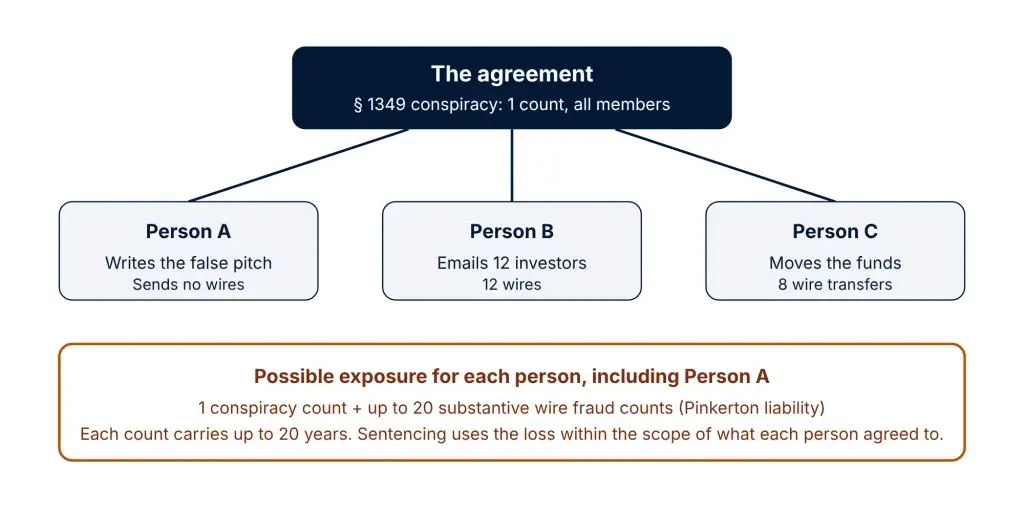
Illustration only. Whether each count applies depends on the facts, and judges decide sentences under the Sentencing Guidelines, not by adding up statutory maximums.
Sentencing works a little differently. The guidelines hold a defendant accountable for “jointly undertaken criminal activity” only when the conduct was within the scope of what that person agreed to, in furtherance of it, and reasonably foreseeable (USSG §1B1.3). That narrower test is often where a minor participant’s sentence is won or lost.
§ 1349 vs. § 371: Two Ways to Charge a Fraud Conspiracy
Prosecutors can also charge a fraud conspiracy under the general conspiracy statute, 18 U.S.C. § 371. The choice matters because the two statutes carry very different maximum sentences.
| 18 U.S.C. § 1349 | 18 U.S.C. § 371 | |
|---|---|---|
| What it covers | Conspiracies to commit Chapter 63 fraud offenses (wire, mail, bank, health care, securities fraud) | Conspiracies to commit any federal offense, or to defraud the United States |
| Overt act required? | No | Yes. At least one conspirator must take a step to carry out the plan |
| Maximum prison term | Same as the object offense: 20 years for wire fraud, 30 if a financial institution is affected | 5 years |
| When prosecutors use it | Most modern wire and mail fraud conspiracies | Mixed-object conspiracies, schemes to defraud a federal agency, or as a lesser charge in plea negotiations |
Because § 371 caps the sentence at five years, negotiating a plea to a § 371 count instead of § 1349 can sharply limit a client’s exposure.
Why Prosecutors Charge Conspiracy
A conspiracy count gives the government several advantages it would not have with a wire fraud charge alone:
- Co-conspirator statements come in as evidence. Under Federal Rule of Evidence 801(d)(2)(E), statements one conspirator made during and in furtherance of the conspiracy can be used against all of them, even if the speaker never testifies.
- Everyone is tried together. Joint trials let prosecutors present the whole scheme to one jury, which can blur the line between major and minor participants.
- Venue expands. The case can usually be brought in any district where any act in furtherance of the conspiracy took place.
- The clock starts later. The five-year statute of limitations (ten years if the fraud affected a financial institution) generally runs from the last act in furtherance of the conspiracy, not from the day a person joined.
- Cooperation pressure builds. Once one member agrees to cooperate, the others face that person’s testimony. In FY2025, 14% of federal fraud sentences included a substantial assistance reduction.
Penalties for Conspiracy to Commit Wire Fraud
Because § 1349 borrows the penalty of the object offense, a wire fraud conspiracy carries the same maximums as the penalty for wire fraud itself.
| Consequence | Maximum or rule |
|---|---|
| Prison | 20 years per count. 30 years if the scheme affected a financial institution or involved disaster or emergency benefits |
| Fine | Up to $250,000 for individuals or $500,000 for organizations, or twice the gain or loss (18 U.S.C. § 3571). Up to $1 million if a financial institution was affected |
| Restitution | Mandatory repayment of victims’ losses in most cases, often joint and several, meaning each defendant can be ordered to pay the full amount |
| Forfeiture | Property traceable to the scheme, such as bank accounts, homes, and vehicles |
How a Federal Wire Fraud Conspiracy Sentence Is Calculated
For a § 1349 conspiracy, the Sentencing Guidelines point to the same guideline as the underlying fraud (USSG §2X1.1 to §2B1.1). The main driver is the loss amount attributable to the defendant, followed by enhancements for the number of victims, sophisticated means, and abuse of trust.
Conspiracy cases also turn on role adjustments. An organizer or leader can receive up to four additional offense levels, while a minimal participant can receive up to a four-level reduction. A defendant with no criminal history points may also qualify for a two-level reduction as a zero-point offender. These adjustments, together with the scope of the agreement, often matter more than the statutory maximum.
Defenses to a § 1349 Conspiracy Charge
No Agreement
Working at the same company, sharing an office, or knowing the people involved does not prove an agreement. Parallel conduct by people acting independently is not a conspiracy. Many defendants in fraud cases are employees who followed instructions without understanding the scheme.
Lack of Knowledge or Intent
The government must prove the defendant knew the scheme was fraudulent and joined it intending to defraud. A good-faith belief that the business, product, or investment was legitimate is a complete defense to intent, even if that belief turned out to be wrong.
Multiple Conspiracies, Not One
Prosecutors often charge one large conspiracy when the evidence shows several smaller, separate ones. If a defendant only dealt with one “spoke” of a hub-and-spoke operation, the defense can argue they never agreed to the larger scheme and should not be held responsible for its full loss amount.
Withdrawal
A person who takes an affirmative step to leave the conspiracy, such as telling the other members or reporting it to authorities, can cut off liability for later acts and start the statute of limitations running. The Supreme Court held in Smith v. United States (2013) that the defendant bears the burden of proving withdrawal, so it must be documented carefully.
The Object Was Not Wire Fraud
After Ciminelli, schemes that only deprived someone of information, rather than money or property, cannot support a wire fraud conspiracy. Whether the government’s theory fits the statute is often the first question to test.
No Genuine Co-Conspirator
It takes at least two people with genuine criminal intent to form a conspiracy. An agreement made only with an undercover agent or a government informant is not a conspiracy.
Statute of Limitations
The government generally has five years from the last act in furtherance of the conspiracy to bring charges, or ten years if the fraud affected a financial institution. Older conduct may be time-barred, especially for a defendant who withdrew.
Where Wire Fraud Conspiracy Charges Come From
Section 1349 shows up in almost every kind of multi-person fraud case, including:
- Investment schemes, where promoters and salespeople are charged alongside the organizer of a Ponzi scheme or fraudulent fund.
- Loan and lending fraud, including pandemic-era loan applications and schemes that also involve bank fraud.
- Health care billing, where § 1349 also covers conspiracies to commit health care fraud under § 1347.
- Business email compromise and online scams, where people who receive and forward stolen funds are charged as co-conspirators, often with money laundering.
- Telemarketing and sales operations, where callers and managers following a script are charged along with the owners.
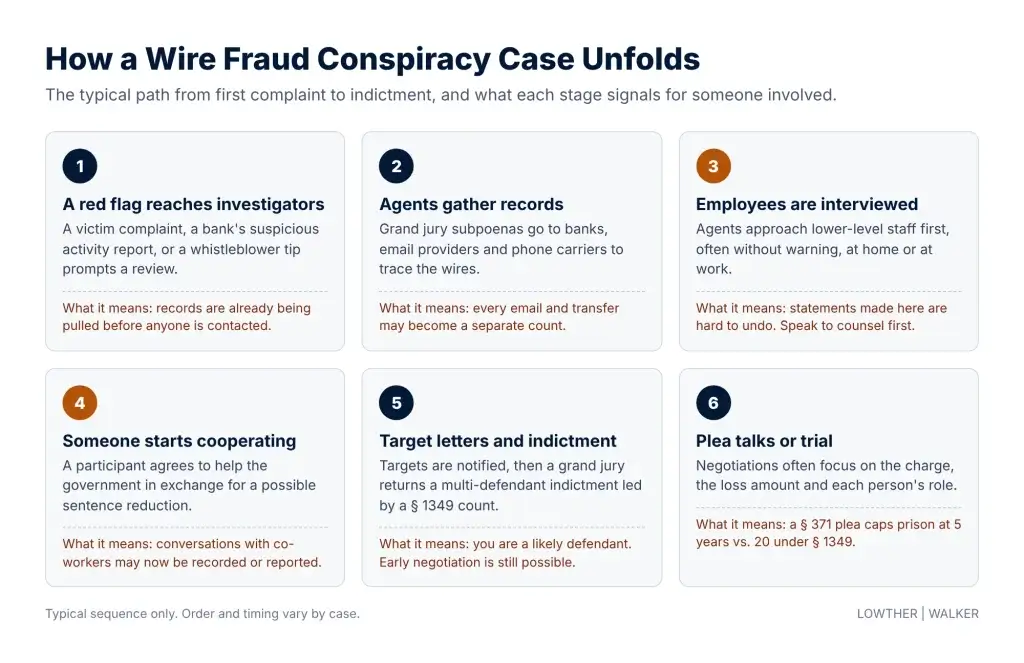
What to Do If You Are Under Investigation
In a conspiracy case, the people you worked with may already be talking to the government. Protect yourself before you say anything:
- Find out your status. A subpoena, an agent’s visit, or a target letter each signal something different. Our guide to whether you are a subject or a target explains the difference.
- Do not discuss the case with co-workers or business partners. A conversation with someone who is cooperating can become evidence of the agreement.
- Do not agree to an interview without counsel. If agents arrive unannounced, read what to do when FBI agents show up at your home.
- Preserve every record. Deleting emails, texts, or files after learning of an investigation can lead to obstruction charges.
Charged With Conspiracy to Commit Wire Fraud? Book a Free Consultation
In a conspiracy case, the first person to cooperate shapes the case everyone else answers. Lowther | Walker defends people accused of federal wire fraud conspiracy nationwide, including employees who never knew the full scheme. Talk to us before you talk to agents.
Request a confidential consultation or call (404) 496-4052.
Frequently Asked Questions
Can I be convicted of conspiracy if the fraud never happened?
Yes. The crime is the agreement. Under § 1349, the government does not have to prove that the scheme succeeded, that anyone lost money, or that any overt act was taken.
Can I be charged with both wire fraud and conspiracy?
Yes. Conspiracy and the completed offense are separate crimes, so prosecutors routinely charge both, along with a separate wire fraud count for each wire transfer or email.
What if I didn’t know everyone involved?
That alone is not a defense. A person can join a conspiracy without knowing every member or every detail. The question is whether they knew the scheme’s fraudulent purpose and agreed to help.
Is conspiracy to commit wire fraud a felony?
Yes. It is a federal felony carrying up to 20 years per count, or up to 30 years when a financial institution is affected.
Sources
- 18 U.S.C. § 1349, Attempt and conspiracy, Legal Information Institute.
- 18 U.S.C. § 1343, Fraud by wire, radio, or television, Legal Information Institute.
- United States v. Roy, 783 F.3d 418 (2d Cir. 2015).
- Pinkerton v. United States, 328 U.S. 640 (1946).
- Ciminelli v. United States, 598 U.S. 306 (2023).
- Kousisis v. United States, 605 U.S. 114 (2025).
- Smith v. United States, 568 U.S. 106 (2013).
- U.S. Sentencing Commission, Quick Facts: Theft, Property Destruction, and Fraud, Fiscal Year 2025.
- U.S. Sentencing Commission, Guidelines Manual, §§1B1.3, 2B1.1, 2X1.1, 3B1.1, 3B1.2, 4C1.1.