

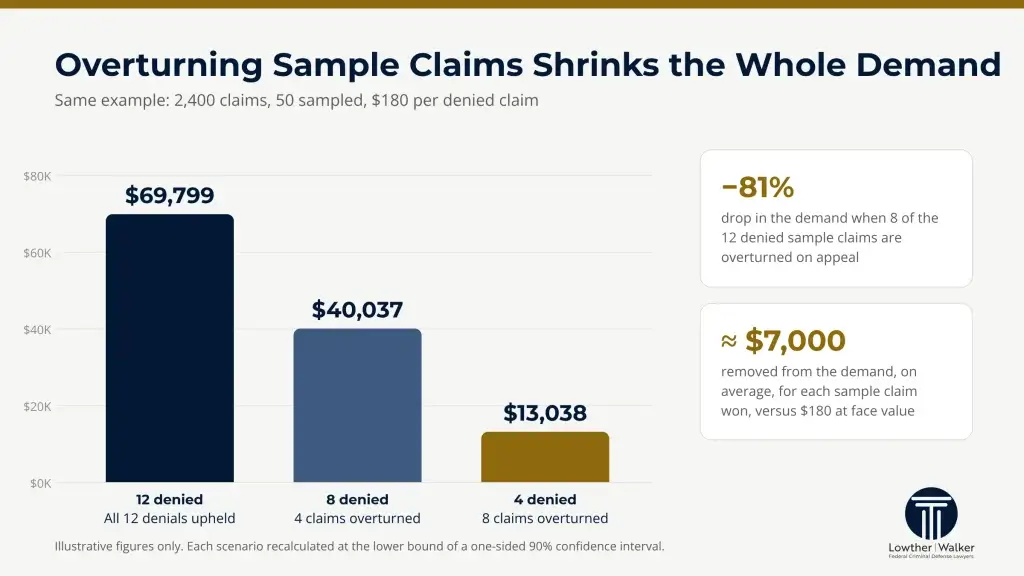
You can challenge an extrapolated Medicare overpayment in two ways: attack the statistical method behind it, or overturn the claim denials it was built on. Contractors must follow the sampling rules in Chapter 8 of the Medicare Program Integrity Manual. A flawed sampling frame, non-random selection, or an incorrect calculation can sharply reduce demand or invalidate it. And because every sample claim is multiplied across all your claims, winning even a few on appeal can cut the amount owed by tens of thousands of dollars.
What Is Extrapolation in a Medicare Audit?
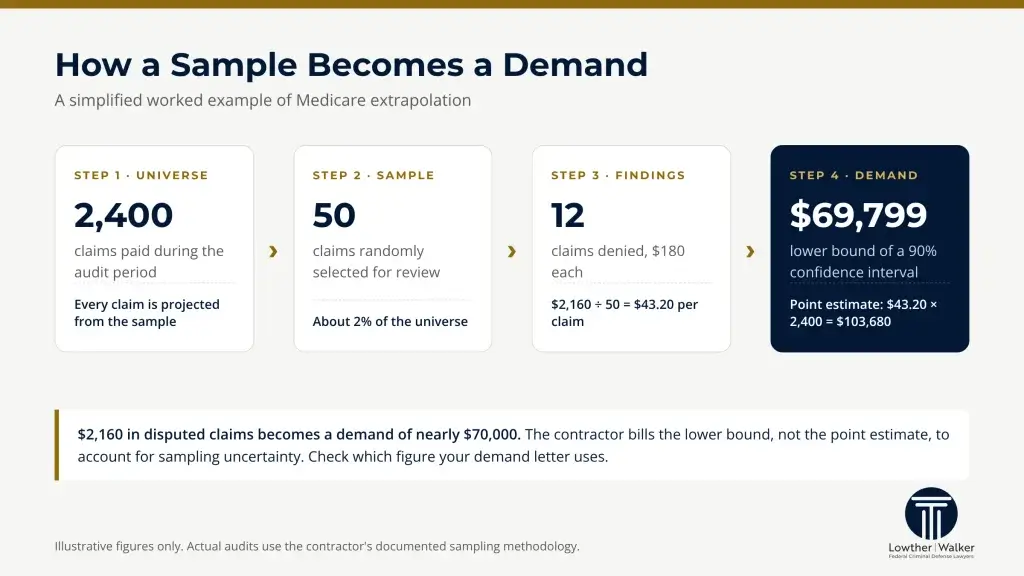
Instead of reviewing every billed claim, a contractor reviews a random sample, measures the overpayment in that sample, and projects it onto the full group of claims, called the universe. This is common in UPIC and RAC audits.
Under 42 U.S.C. § 1395ddd(f)(3), Medicare can extrapolate only after finding a sustained or high level of payment error, or when education failed to fix the problem. That threshold decision cannot be appealed, so most defenses focus on how the sample was built and calculated.
Where Extrapolations Commonly Go Wrong
Small statistical errors can change the final number.
| Problem | What to Look For | Potential Impact |
|---|---|---|
| Flawed universe or sampling frame | Claims outside the audit period, zero-paid claims, or services already reviewed | Demand may need to be recalculated or set aside |
| Non-random selection | No documented random number seed or software output | Sample validity is in question |
| No stratification | High- and low-dollar services pooled together | Inflated or unreliable estimate |
| Low precision | Very wide confidence interval from a small sample | Projection may be unreliable |
| Wrong calculation | Demand based on the point estimate instead of the lower bound of a 90% confidence interval | Overstated demand |
| Missing documentation | Contractor cannot reproduce its own sample | Grounds to challenge the entire extrapolation |
Request the Sampling File First
First, ask the contractor for its complete statistical documentation: the universe and frame data, the random number seed and software output, the sample claim list and the statistician’s calculations. Contractors must keep enough documentation to recreate the sample. An independent statistician can then rerun the numbers and test every assumption.
Two Ways to Reduce the Demand
The strongest defenses combine a statistical challenge with a claim-by-claim review. Coding and medical records experts revisit each denied sample claim to show medical necessity, proper documentation, or correct coding. When a sample claim is reversed on appeal, the contractor must recalculate the extrapolation, so every win shrinks the total.
When to Raise Extrapolation Challenges
| Appeal Level | Deadline to File | Extrapolation Focus |
|---|---|---|
| Redetermination (MAC) | 120 days | Request the sampling file and dispute denied sample claims |
| Reconsideration (QIC) | 180 days | Submit the statistician’s report and all supporting records |
| ALJ hearing | 60 days | Expert testimony on sampling flaws and claim merits |
Submit your full evidence at reconsideration, because adding new evidence later generally requires good cause. Filing the redetermination within 30 days and the reconsideration within 60 days also stops Medicare from recouping the money while those appeals are pending. Our Medicare audit defense lawyers can manage these deadlines for you.
How Lowther | Walker Can Help

Our team fights extrapolated demands with:
- Independent statisticians who test the contractor’s sampling method
- Coding and medical records experts who review every denied sample claim
- Appeals at every level, from redetermination to ALJ hearing
- Deadline management that limits recoupment during appeals
- Federal criminal defense experience if an audit becomes an investigation
Schedule a confidential consultation to review your demand letter.
Frequently Asked Questions
Is extrapolation legal in Medicare audits?
Yes. Courts have upheld statistical sampling for Medicare overpayments since HCFA Ruling 86-1 and Chaves County Home Health Service v. Sullivan (D.C. Cir. 1991). Providers can still challenge how sampling was applied in their case.
Should I pay the demand while I appeal?
Paying or recoupment does not end your right to appeal. If you win, Medicare must return the money, generally with interest. Providers facing hardship can ask about an extended repayment schedule.
Do Medicaid and private insurers extrapolate too?
Many do. State Medicaid programs and commercial payers often use sampling, but the rules depend on state law and your provider contracts. Our lawyers defend Medicaid providers facing extrapolation during Medicaid audits.
Does an extrapolated overpayment mean I’m suspected of fraud?
Not necessarily. Extrapolation is an administrative recovery tool. However, high error rates can trigger referrals to investigators, so respond with counsel.