
With increasing federal resources allocated to healthcare fraud investigations, your healthcare firm’s billing practices must be faultless. In running your healthcare practice, you may not have a clear insight into the billing procedures that lead to a federal investigation and potentially criminal prosecution for healthcare fraud.
Lowther | Walker’s experience in healthcare fraud billing investigations and compliance analysis for healthcare providers places our lawyers in a prominent position to advise on legal billing within the healthcare space. And within this post, we’ll explore more about the billing practices that may expose your business to a fraud investigation.
Incorrect Billing Codes
The simple addition or subtraction of a digit may increase the potential of your company facing a fraud investigation. Submitting incorrect billing codes is a violation under the FCA for “knowingly submitting false claims,” and you then require the legal guidance of a healthcare fraud defense attorney to investigate and identify the cause of the billing code error.
Modifying Billing Codes
Modifiers help explain more about a specific code and the related product or service for billing. However, the CMS only allows the modification of billing codes under narrow circumstances and has a detailed procedure for modified billing code submission. Failure to adhere to the CMS guidelines may constitute billing fraud.
Double Billing
Examples of double-billing cases include billing the same federal healthcare agency for the same service more than once and billing multiple government programs for the same services. Double-billing can occur when your administrative team works with patients using different government programs, as team members may compile all patient-specific services under one billing structure.
Billing for Not-Medically Necessary Services
Federal programs such as Medicare only provide services deemed medically necessary. If a CMS healthcare audit finds you or your team have billed for a service they deem unnecessary, you can face further investigation and potentially criminal charges for healthcare fraud.
Steps Healthcare Organizations Can Take to Reduce Legal Risk of Billing Errors
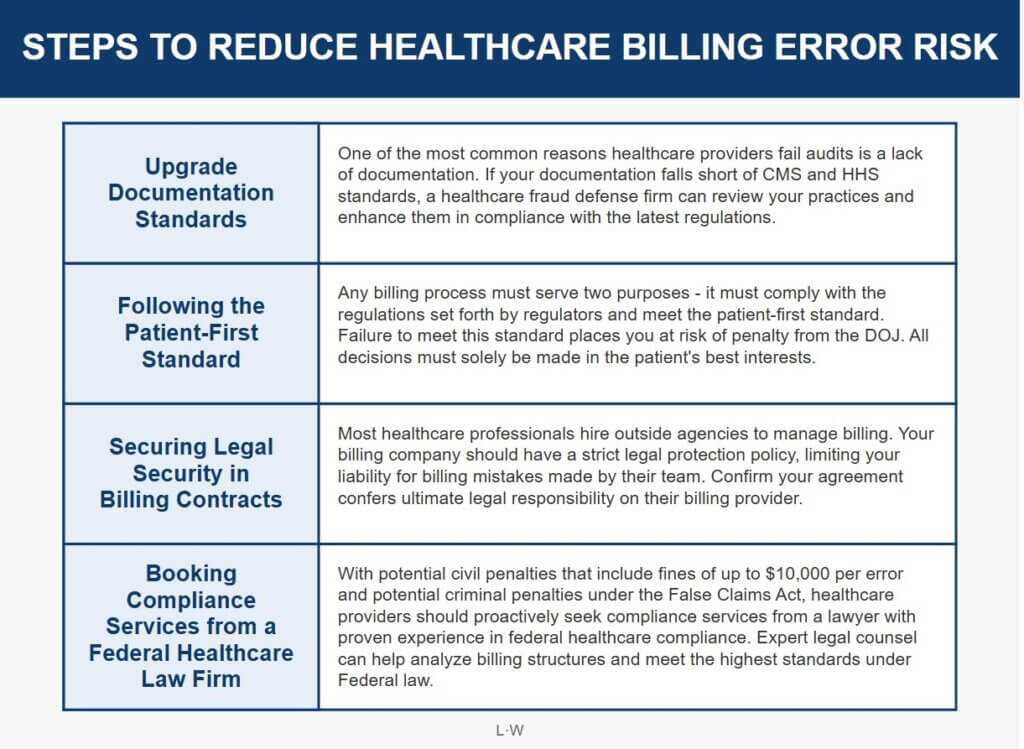
Upgrade Documentation Standards
One of the most common reasons healthcare providers fail audits is a lack of documentation. If your documentation falls short of CMS and HHS standards, a healthcare fraud defense firm can review your practices and enhance them in compliance with the latest regulations.
Following the Patient-First Standard
Any billing process must serve two purposes – it must comply with the regulations set forth by the regulators and meet the patient-first standard. Failure to meet this standard places you and your healthcare business at risk of penalty from the DOJ for not protecting patient rights. Any decision, such as a treatment recommendation or a referral, must solely be made in the patient’s best interests.
Securing Legal Security in Billing Contracts
Most healthcare professionals now hire outside agencies to manage their billing procedures. The billing company you work with should have a strict legal protection policy, limiting your level of liability for billing mistakes made by their team. Confirm your agreement confers ultimate legal responsibility on your billing provider, and clarify any liability issues with your provider before finalizing working contracts.
Booking Compliance Services from a Federal Healthcare Law Firm
With potential civil penalties that include fines of up to $10,000 per error and the potential for criminal penalties for making fraudulent claims under the False Claims Act, healthcare providers should proactively seek compliance services from a lawyer with proven experience in federal healthcare compliance. Lowther | Walker is the U.S. leader in healthcare fraud defense and billing compliance, helping medical providers analyze their current billing structures and meet the highest standards under Federal law.
Call Lowther | Walker for a Free Healthcare Billing System Consultation
Federal defense lawyers Lowther | Walker hold years of experience defending medical providers in billing fraud cases. Our team has an encyclopedic knowledge of healthcare defense law and can help you and your team improve your billing practices based on the latest regulatory frameworks. We serve medical professionals across the country, responding to billing fraud cases nationwide.
Call Lowther | Walker at (404) 496-4052 for your free, confidential consultation for clear answers to your healthcare billing compliance questions.
Answers to Your Healthcare Billing Questions
What is the difference between a healthcare billing error and healthcare fraud?
A healthcare billing error is generally an unintentional mistake involving medical coding, documentation, claims submission, or reimbursement. Healthcare fraud, by contrast, generally involves knowingly submitting false or misleading information to obtain payment. Common issues include upcoding, unbundling, duplicate billing, billing for services not provided, and claims that lack adequate medical documentation.
Can an innocent billing mistake lead to a healthcare fraud investigation?
Yes. An isolated billing mistake does not necessarily constitute healthcare fraud, but repeated billing discrepancies or unusual claims patterns can attract attention from agencies such as HHS-OIG, the FBI, DOJ, CMS, or state Medicaid authorities. Investigators may examine whether the errors resulted from employee mistakes, inadequate training, software problems, poor compliance controls, or intentional conduct.
What types of billing errors can result in healthcare fraud allegations?
Potentially serious billing issues include upcoding, unbundling services, duplicate billing, billing for medically unnecessary services, billing for services never provided, incorrect modifiers, and submitting claims that are inconsistent with patient records. The circumstances surrounding the error, including knowledge and intent, can be important in determining whether the matter is treated as a compliance issue or a healthcare fraud investigation.
What is upcoding and when can it constitute healthcare fraud?
Upcoding occurs when a provider submits a billing code for a more expensive or extensive service than the service actually provided. An isolated coding mistake may be a billing error, while knowingly submitting higher-value codes can result in allegations involving Medicare fraud, Medicaid fraud, or violations of the False Claims Act. Documentation, billing practices, internal communications, and intent may all become relevant.
Is duplicate billing considered healthcare fraud?
Duplicate billing occurs when multiple claims are submitted for the same healthcare service when only one payment is appropriate. Duplicate claims can result from administrative mistakes, billing software problems, or employee errors. However, knowingly or repeatedly submitting duplicate claims may create significant exposure in a Medicare, Medicaid, or federal healthcare fraud investigation.
How can a healthcare provider defend against billing fraud allegations?
A healthcare fraud defense should begin with a detailed review of the claims, medical records, billing procedures, coding practices, compliance policies, and communications surrounding the alleged conduct. A defense attorney may investigate whether the problem resulted from an isolated billing error, employee conduct, inadequate training, systemic compliance failures, or intentional activity. Establishing the actual circumstances behind disputed claims can be critical.
Which government agencies investigate healthcare billing fraud?
Healthcare billing investigations can involve the Department of Justice, Federal Bureau of Investigation, HHS Office of Inspector General, Centers for Medicare & Medicaid Services, state Medicaid agencies, and federal or state prosecutors. The agency involved generally depends on the healthcare program, alleged conduct, geographic jurisdiction, and nature of the suspected billing violations.
How does the False Claims Act apply to healthcare billing errors?
The federal False Claims Act can create liability when false or fraudulent claims are knowingly submitted, or caused to be submitted, for payment by the government. Healthcare providers may face False Claims Act allegations involving Medicare, Medicaid, and other federally funded healthcare programs. A billing discrepancy does not automatically establish liability, and the specific facts surrounding the claim are important.
What should a healthcare provider do after discovering billing errors?
A healthcare provider should preserve relevant billing and medical records, determine the scope and cause of the errors, and evaluate the appropriate corrective action. Depending on the circumstances, this may involve an internal billing audit, compliance review, claim correction, repayment of an overpayment, or consideration of a voluntary disclosure. Providers should carefully evaluate potential legal consequences before making significant admissions or disclosures.
When does a healthcare billing error become healthcare fraud?
A billing error can become a healthcare fraud matter when the evidence supports allegations that false information was knowingly or intentionally submitted, or that other legally actionable conduct occurred. Investigators may examine billing patterns, medical records, employee communications, compliance policies, training, prior warnings, and how the provider responded after discovering the problem. The distinction between an innocent billing error and fraudulent conduct often depends on the complete factual circumstances.