
A federal “target letter” is a formal communication from the Department of Justice (DOJ) informing you that you’re the target of a federal investigation. Receiving a target letter from federal authorities can be one of the most alarming experiences in a person’s life.
This comprehensive guide from our white collar criminal defense lawyers explains everything you need to know about target letters and the steps to take upon receiving one.
What Is a Target Letter?
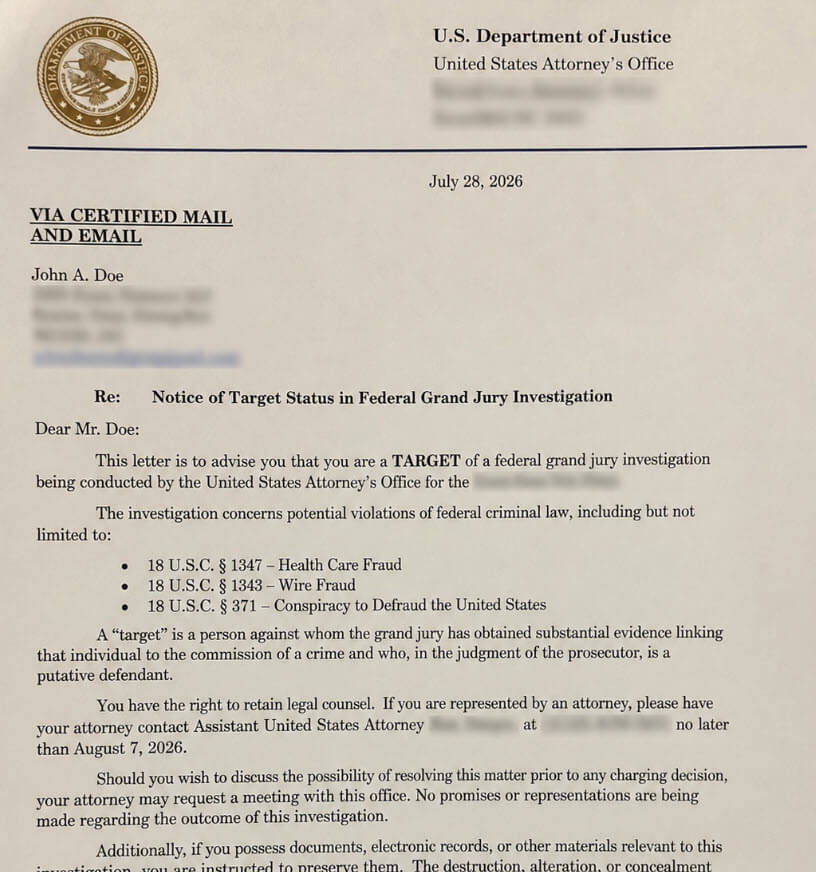
A “target letter” from the federal government informs the recipient that they are targets for criminal prosecution. If you receive a target letter, the federal prosecutor believes you have committed a crime. More specifically, a U.S. attorney has substantial evidence linking you to the commission of a crime.
By the time you receive a target letter, you are a subject within a federal investigation, and the prosecution has moved beyond general enquiries and begun a formal investigation.
Target Letters Versus Indictments
| Target Letter | Indictment | |
|---|---|---|
| Definition | A formal notice from federal prosecutors informing a person that they are the target of a criminal investigation. | A formal charge issued by a grand jury stating there is probable cause to believe the person committed a federal crime. |
| Stage in Process | Early stage — before any formal charges are filed. | Later stage — after the grand jury has voted to bring charges. |
| Purpose | To notify the recipient they are under investigation and may face charges; sometimes used to encourage cooperation or plea discussions. | To officially accuse and initiate criminal prosecution in federal court. |
| Who Issues It | U.S. Attorney’s Office (federal prosecutors). | A federal grand jury, based on evidence presented by prosecutors. |
| Legal Effect | Does not charge a crime — it’s a warning or notice. | Formally charges a crime — the defendant must appear in court to answer the charges. |
| Rights of the Individual | The person is not yet a defendant but has the right to seek counsel and may be invited to testify before the grand jury. | The person becomes a defendant and has the right to counsel, to plead, and to prepare a defense. |
| Public or Private | Private — sent directly to the target and their attorney. | Public — filed in federal court and becomes part of the court record. |
| Typical Next Step | The individual may be indicted, cooperate with prosecutors, or attempt to avoid charges. | The case proceeds to arraignment, pretrial motions, plea bargaining, or trial. |
What Does a Target Letter Include?
Target letters typically contain the following elements:
Identification of the investigating agency
The letter will specify which federal agency is conducting the investigation (FBI, DEA, IRS, etc.).
Nature of the alleged crime
The letter will identify the specific federal statute(s) you’re suspected of violating.
Grand jury proceedings
Target letters often include an invitation to testify before a federal grand jury, a critical aspect of the grand jury investigation process.
Response deadlines
The letter will specify deadlines for response or appearance.
Contact information
Within the letter, you’ll find contact details for the Assistant U.S. Attorney handling the case.
Why Might You Receive a Target Letter?
Target letters are issued in a wide variety of federal criminal investigations, including:
White-collar crimes
A target letter for white-collar crimes means federal prosecutors believe you played a key role in a financial or corporate scheme involving deception for personal or organizational gain. This can include tax evasion (willfully hiding income or falsifying returns), securities fraud (misleading investors or trading on inside information), embezzlement (misusing funds entrusted to your care), or money laundering (concealing the source of illegally obtained money).
Receiving such a letter indicates that investigators already have substantial evidence, such as financial records, communications, or witness testimony, linking you directly to intentional acts of fraud or financial misconduct, and that you are now a primary focus of a federal criminal investigation.
Healthcare fraud
If you receive a target letter related to healthcare fraud, the Department of Justice suspects you knowingly submitted or facilitated false claims for payment to Medicare, Medicaid, or private insurers. Common allegations include billing for services not provided, inflating charges, or kickback arrangements. It indicates that investigators have linked your billing activity or business practices to possible federal offenses under the False Claims Act or Anti-Kickback Statute.
Government contract fraud
A target letter in a government fraud case shows that prosecutors are examining your involvement in manipulating federal contracts. This could include bid rigging, submitting false claims, or accepting kickbacks. It shows that investigators believe you intentionally defrauded the government or interfered with fair contracting processes to gain an improper advantage.
Conspiracy charges
Receiving a target letter for conspiracy suggests that you’re suspected of coordinating with others to commit a federal crime, even if you didn’t carry out the act yourself. Prosecutors use conspiracy charges to connect multiple individuals to a broader criminal enterprise — such as fraud, bribery, or smuggling. The letter represents you as an active participant in an organized illegal operation.
Regulatory violations
A target letter for regulatory violations indicates that federal authorities believe you broke laws governing environmental protection, customs, or trade compliance. These letters often follow investigations by agencies like the EPA or CBP and allege knowing violations of federal regulations. It typically means the evidence points to deliberate or reckless disregard of compliance requirements.
Public corruption
In public corruption cases, a target letter indicates prosecutors believe you abused your position of authority for personal or political gain. Allegations may include bribery, misuse of government funds, or violating campaign finance laws. The letter warns that the government has substantial proof linking your official actions to unlawful benefit or influence.
What to Do After Receiving a Target Letter
Step 1: Do Not Panic, But Act Immediately
This letter does not indicate you are guilty, but it does signal that you are under criminal investigation. While receiving a target letter is serious, it’s important to remember that being a target doesn’t guarantee you’ll face an indictment. However, time is of the essence.
Step 2: Retain Experienced Federal Criminal Defense Counsel
Your first step should be to retain experienced legal counsel to guide you through this complex process. Don’t try to handle the response to a target letter alone. One mistake within the process can lead to your prosecution in federal court. Call Lowther | Walker for a free, confidential consultation to discuss the claims in the target letter.
Why Speak with a Federal Attorney After Receiving a Target Letter?
- Federal criminal law is highly complex and specialized
- The stakes are significantly higher than state-level crimes
- Federal prosecutors have vast resources and experience
- Early intervention can sometimes prevent charges from being filed
Step 3: Preserve All Relevant Documents
Once you retain counsel, work with your attorney to:
- Identify and preserve all potentially relevant documents
- Implement a litigation hold to prevent the destruction of evidence
- Secure electronic data and communications
- Inventory physical evidence that may be relevant
Step 4: Do Not Contact Federal Agents or Prosecutors Directly
Do not talk to federal law enforcement agents. One of the critical mistakes DOJ target letter recipients make is attempting to “clear things up” by speaking directly with investigators. Never contact federal agents or prosecutors without your attorney present. Any statements you make can and will be used against you.
Step 5: Avoid Discussing the Investigation
- Do not discuss the investigation with anyone except your attorney
- Be cautious about communications
- Avoid social media posts related to the investigation
- Instruct family members and employees not to discuss the matter
Step 6: Prepare for Potential Grand Jury Testimony
If you’re invited to testify before a grand jury, it means that the grand jury is interested in hearing your side of the story or any information you might have that could be relevant to the investigation. Your attorney will help you:
- Understand your rights regarding grand jury testimony
- Prepare for potential brand jury questions
- Decide whether to testify or invoke your Fifth Amendment rights
- Navigate the complex rules governing grand jury proceedings
Step 7: Develop a Comprehensive Defense Strategy
Your federal attorney can help you develop a comprehensive defense strategy in response to the criminal investigation target notice, which will include:
- Analyzing the government’s potential evidence
- Identifying weaknesses in the prosecution’s case
- Exploring opportunities for cooperation if appropriate
- Preparing for follow-up steps, including plea negotiation or trial
Step 8: Consider Cooperation Opportunities
Typically, each FBI target letter concludes with a request to contact the federal authorities. In some cases, cooperation with the government may be beneficial. But this decision should only be made in coordination with experienced counsel.
What NOT to Do After Receiving a Target Letter
- Don’t ignore the letter: It’s often best to respond promptly with guidance from a lawyer.
- Don’t contact investigators directly: All communication should go through your attorney.
- Don’t destroy any documents: It could result in additional obstruction charges
- Don’t discuss the case with others: Even private discussions can compromise your defense.
- Don’t assume you’ll be charged: Being a target doesn’t guarantee indictment.
Frequently Asked Questions About Target Letters
Does receiving a target letter mean I will definitely be charged?
No. While being designated as a target means prosecutors believe they have substantial evidence against you, it doesn’t guarantee charges will be filed. With qualified legal representation, it may be possible to avoid charges entirely.
How long do I have to respond to a target letter?
Target letters typically specify a deadline for response, often within 10-30 days. However, your attorney may be able to negotiate extensions or modified timelines.
Can I refuse to testify before a grand jury?
Yes, you have the right to invoke your Fifth Amendment privilege against self-incrimination. However, this decision should be made in consultation with your attorney after careful consideration of all factors.
What’s the difference between being a “target” and a “subject”?
If you are a target of a federal investigation, the government thinks they have “substantial evidence” linking you to a crime, and the prosecutor believes you will likely be indicted. If you are a “subject” of a grand jury investigation, your conduct is merely “within the scope” of the investigation, but prosecutors don’t necessarily have substantial evidence against you.
How long do federal investigations typically last?
Federal investigations can last anywhere from several months to several years. The timeline depends on the complexity of the case, the number of defendants, and the resources available to both sides.
What are the potential consequences if I’m indicted?
Federal crimes typically carry severe penalties, including lengthy prison sentences, substantial fines, and long-term collateral consequences that affect employment, professional licenses, and civil rights.
Can my employer find out about the investigation?
While grand jury proceedings are secret, investigations may become public in various ways. Discuss with your attorney how to handle employment-related concerns.
Schedule Your Target Letter Consultation Today

If you’ve received a target letter from federal authorities, time is limited. The experienced federal criminal defense team at Lowther | Walker understands the gravity of your legal position and can provide the aggressive, knowledgeable representation you need.
Why Choose Lowther | Walker?
- Federal Criminal Defense Experience
Our attorneys have extensive experience handling complex federal criminal cases.
- Immediate Response
We understand the urgency of target letter matters and respond quickly to consultation requests.
- Comprehensive Approach
We handle every aspect of your case, from initial investigation through trial if necessary
- Proven Results
Our track record includes successful case dismissals, reduced charges, and favorable plea agreements. Don’t put off responding to your target letter any longer.
Request your free consultation with the defense attorneys at Lowther Walker by booking online or calling our offices directly at (877) 208-7146.